
Our History
More Than a Century of Service
The story of the Glen Rock Hose & Ladder Company begins before the company itself existed. From a hand-drawn pumper and a small group of volunteers to generations of service to Glen Rock and the surrounding community, the history of the fire company is closely woven into the history of the town itself.
Before the Fire Company
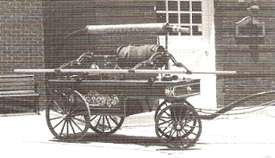
Following several destructive fires in Glen Rock, the borough purchased a used 1849 Rumsey hand-drawn pumper prior to 1888. Four firefighters worked the wooden handles on each side of the apparatus, operating piston pumps that forced water through the fire hose.
Water was drafted from whatever sources were available, including cisterns, wells, the millrace, Codorus Creek and the millpond. By 1901, Glen Rock had its first water mains and fire hydrants, significantly improving the community's ability to fight fires.
Glen Rock Borough Council called a public meeting to organize a fire company. Forty-five men initially volunteered.
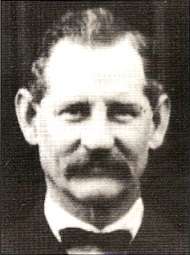
Allen M. Seitz was elected president, I. Palmer Diehl secretary and Isaiah Young treasurer. E.S. Hiteshue, M.L. Kapp and Edward Slonaker were appointed to draft a constitution and bylaws for the new organization.

Organizing the Company
On October 7, 1901, another meeting was held in the Knights of Pythias Hall on Main Street. Officers elected for the coming year included President A.M. Seitz, First Vice President M.L. Kapp, Second Vice President G.F. Miller, Secretary I. Palmer Diehl, Treasurer Isaiah Young and Chaplain Rev. L.S. Reichard.
E.S. Hiteshue served as Foreman, the position corresponding to fire chief, with Isaiah Young as Assistant Foreman. Other members were appointed as hose directors, pipemen, trustees and members of the investigating and nominating committee. These men became the first officers of the Glen Rock Hose & Ladder Company.
At the company's third meeting on October 11, annual membership dues were established at $1.00. Copies of the constitution and bylaws were distributed and the company asked Borough Council to help secure a permanent meeting place.
“Old Mark” Comes Home
Glen Rock Borough Council formally turned the 1849 Rumsey hand-operated pumper over to the newly organized fire company.
The pumper became known as “Old Mark” in honor of Mark Radcliffe, who served as Glen Rock's chief burgess. Radcliffe came to Glen Rock from England around 1849 and was a rope manufacturer as well as one of the community's early leaders.
The Foust building on Baltimore Street was secured to house Old Mark. A large plate-glass window allowed townspeople to see the apparatus from the street.
Members later preserved and reconditioned the historic pumper because they recognized what it represented: the beginning of organized firefighting in Glen Rock.
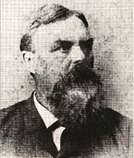
Glen Rock's chief burgess and the man for whom the historic Rumsey hand pumper “Old Mark” was named.
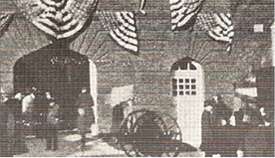
Purchased from Goodwill Fire Company of York for $100. Before its arrival, Glen Rock firefighters carried hose to fire scenes themselves.
Equipping and Building the Company
In late 1901 or early 1902, the company purchased a hose carriage from Goodwill Fire Company of York for $100. The Northern Central Railroad transported it to Glen Rock free of charge. Before the carriage was acquired, firefighters carried the hose to fire scenes themselves.
Protecting the Firefighters
On February 14, 1902, trustees were instructed to purchase six rubber coats and caps from E.R. Miller and Company of Glen Rock. The following month, three additional coats and caps were ordered along with 12 lanterns and a 40-foot wooden ladder.
On June 30, 1902, the company responded to a kitchen fire at the Cold Spring Hotel on Main Street. The fire was extinguished with minimal damage.
Fundraising for Better Equipment
Supporting a volunteer fire company required creativity from the very beginning. During the summer of 1902, the company took responsibility for sprinkling Glen Rock's dusty dirt streets. The work produced $39.55 in July and $49.45 in August.
A lawn festival brought in another $177.10. In November, a Thanksgiving Fair and Festival chaired by E.S. Hiteshue produced a remarkable profit of $852.25 with help from Glen Rock residents, local businesses, volunteers, the Glen Rock Orchestra and the Glen Rock Band. The money helped the company purchase badly needed firefighting equipment.
The Company Receives Its Charter
In January 1903, President A.M. Seitz reported that an application had been made for a fire company charter. At the same time, a committee began searching for land on which to construct an engine house.
A property beside the Glen Rock steam bakery on Hanover Street was purchased from W.C. Lau for $650.
On February 25, the company responded to a fire at the Norrish Foundry and Machine Company. The cupola and part of the roof were destroyed before the fire was brought under control. Damage was estimated at $1,000.
The Glen Rock Hose & Ladder Company received its charter in March 1903. The company had 48 original charter members. One of them, M. Guy Lentz, remained a member for 78 years, until his death on October 21, 1979.
View the 48 Original Charter Members
- Allen M. Seitz
- George F. Miller
- Curvin E. Dise
- M.L. Kapp
- Charles Seitz
- J.E. Seitz
- C.A. Seitz
- E.T. Eyster
- Ira Amspacher
- E.S. Hiteshue
- E.W. Heathcote
- T.M. Brown
- I.J. Young
- G.F. Heathcote
- C. Edward Slonaker
- F.G. Kintzing
- Harry Stover
- D.R. Bortner
- I. Palmer Diehl
- W.W. Seitz
- J. Victor Wambaugh
- C.S. Kinkle
- J.S. Little
- Pius Anstine
- Norman Shriver
- George Seebauer
- C.G. Seitz
- Paul Birchall
- L.F. Klinefelter
- Levi Gerbrick
- M. Guy Lentz
- Scott Radcliffe
- Lloyd Miller
- J.E. Venus
- E.B. Radcliffe
- W.O. Bixler
- Homer A. Dise
- James B. Herbst
- Alton Price
- John Radcliffe
- Eckert Bortner
- E.R. Rohrbach
- George F. Wambaugh
- William Baublitz
- W.C. Lau
- J.L. Bortner
- D.M. Roser
- Noah Reever
M. Guy Lentz was a fire company member from 1901 until October 21, 1979.
A Fire Hall for Glen Rock
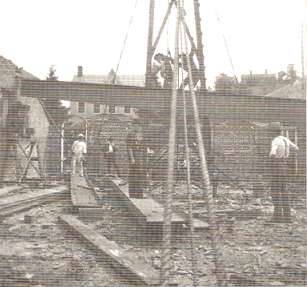
While the charter was being completed, the company began planning an engine house. Architect Joseph Dise discussed plans with the company in March 1903, and his building plans and sketches were accepted that July.
The community helped make the project possible. Standard Screen Works, Wm. Frey and I. Gladfelter donated building stone. The Junior Athletics contributed $50 from a fundraising event, while local citizens donated money to purchase bricks.
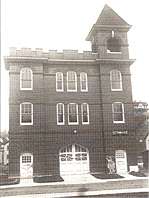
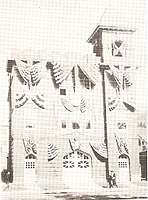
The engine house was completed on December 9, 1904, at a cost recorded as $8,008.23, in addition to the $650 paid for the property.
A Gathering Place for the Community
The new fire hall quickly became much more than a place to house fire apparatus. Over the years it hosted borough council meetings, Boy Scout activities, voting, tax collection, fairs, festivals and other community organizations.
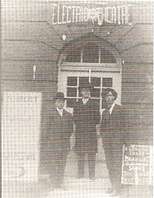
The building even contained a library on the second floor and a basketball court on the third. It was home to the Electric Theater and served as a practice hall for the Glen Rock Carolers Association.
Zion Lutheran Worships at the Fire Hall
Beginning April 9, 1905, the congregation of Zion Lutheran Church held worship services in the third-floor fire hall gymnasium while its new church was being built. Historical records describe Sunday morning and evening services filling the third floor.
After moving into its new church at Hanover and Water Streets, the Zion congregation donated the bell from the old Lutheran church to the Glen Rock Hose & Ladder Company. The bell was used to alert firefighters when a fire occurred.
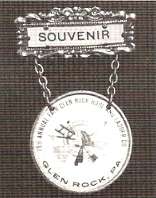
Loss of a Great Volunteer
On October 12, 1918, charter member Harry Stover became seriously ill after fighting a house fire at 155 Hanover Street. He developed influenza and pneumonia and died on October 22.
Fire Chief Roy Heyn reported that he believed Stover's death resulted from fighting the fire. The 1918 influenza and pneumonia epidemic was claiming many lives at the time, however, and the historical record cannot establish whether his firefighting service contributed to his illness and death.
The Fire That Changed Everything
July 1, 1921, was regarded at the time as the darkest day in the history of the Glen Rock Hose & Ladder Company.
A fire broke out in the Read Machinery Company and quickly spread to the neighboring J.F. & H.O. Neuhaus Hardware and Farm Machinery Company on Main Street. Both buildings were destroyed, with losses estimated at $200,000.
Glen Rock's hand-drawn firefighting equipment was no match for the rapidly growing fire. Firefighters concentrated on protecting nearby properties while facing the additional danger of fireworks and dynamite exploding inside the Neuhaus building.
Fire Chief Roy Heyn requested assistance from York. Laurel Fire Company responded with its more modern engine, drafting water from the old millrace and helping bring the fire under control.
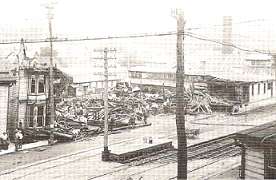
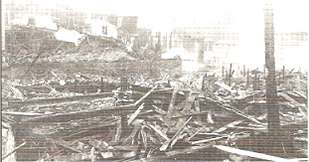
Additional serious fires followed that summer. On July 19 and August 8, fires destroyed the George Bollinger Stable, spread to L. Siltzer's Blacksmith Shop and partially destroyed the S.B. Werner Toy Desk Company.
On August 12, company president S.D. Wareheim appointed a committee to investigate the purchase of a new fire engine.
The Motorized Era Begins
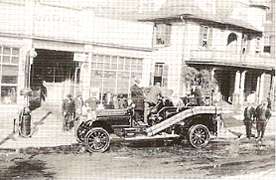
At a special meeting on October 28, 1921, members considered apparatus from White, Ahrens-Fox and American La France. They ultimately voted to purchase a 750-gallon-per-minute American La France pumper.
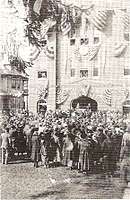
The new engine arrived in Glen Rock on March 1, 1922. It was the company's first motorized fire apparatus and cost $12,500. The engine would eventually become affectionately known as “Old Grandma.”
With the arrival of the American La France, the old Goodwill hose carriage was retired from service. A housing ceremony for the new engine was held on March 22, 1922.
Growing With the Community
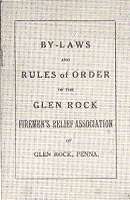
Work began in April 1923 to organize the Glen Rock Firemen's Relief Association. The original formation committee consisted of M. Guy Lentz, M.L. Kapp and Roy M. Heyn.
By 1925, the American La France had answered numerous calls outside Glen Rock as well as those within the community. Only three fire calls were recorded during 1925.
In 1926, the company's meeting room, commonly known as “the parlor,” was completed and furnished at a cost of $1,222.01. By the end of that year, a committee was studying the installation of a siren on the fire house to summon volunteers.
The company responded to a kitchen fire at Hotel Glen, resulting in several hundred dollars in damage.
Glen Rock participated in the State Firemen's Association Convention and Parade in York with the 1922 American La France, Old Mark, 85 marching members and the Glen Rock Band.
The company purchased its first recorded breathing protection. Company records describe the equipment simply as four “respirators.”
York City Fire Chief Ellis Wagner addressed the company on fire prevention and the latest fire suppression techniques.
During the Great Depression, the fire house served as a distribution center for the York County Relief Authority, providing supplies to people in need.
A Tradition Continues
Built by Volunteers. Sustained by Community.
From Old Mark and hand-carried hose to Glen Rock's first motorized engine, the early decades of the Glen Rock Hose & Ladder Company were shaped by volunteers who gave their time, their labor and, in some cases, their lives in service to their neighbors.
Just as important was the community that stood behind them. Residents donated bricks and building stone, attended fairs and festivals, supported equipment purchases and helped turn the fire hall into a gathering place for Glen Rock.
That partnership between volunteer firefighters and the community they serve is the foundation on which the Glen Rock Hose & Ladder Company was built.